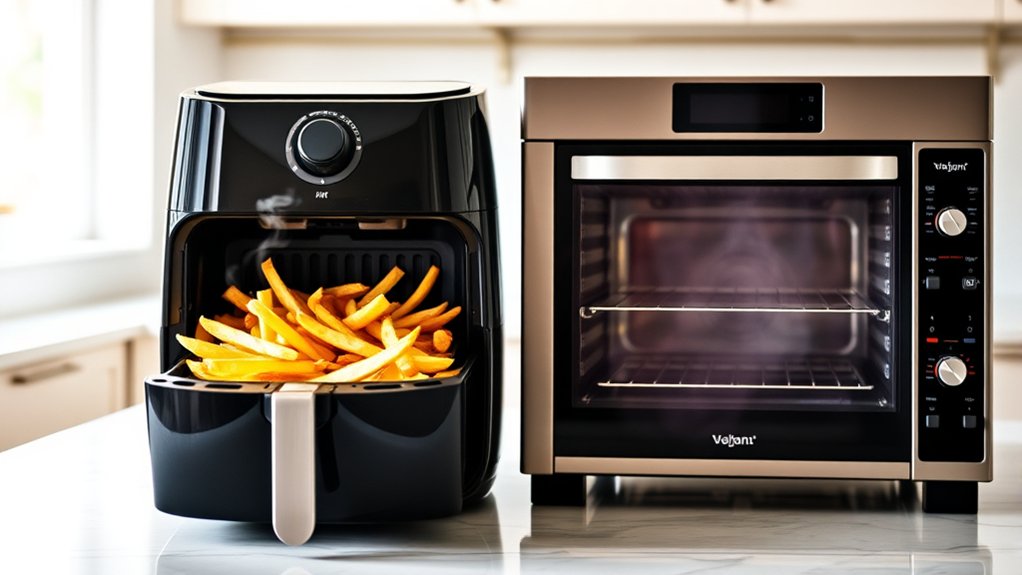
Is an Air Fryer a Convection Oven
Think of an air fryer as a small wind tunnel for heat. You’re really using forced convection: a fan drives hot air across food, and a heating element supplies the energy. That makes an air fryer functionally close to a convection oven, but the tighter chamber and basket geometry change airflow, moisture loss, and browning rates in ways that aren’t trivial.
The distinction matters more than you might expect.
Key Takeaways
- An air fryer uses the same basic principle as a convection oven: hot air circulated by a fan and heating element.
- An air fryer is essentially a small, high-speed convection oven with a compact chamber and basket design.
- The smaller space and stronger airflow make air fryers heat faster and crisp food more aggressively.
- Convection ovens usually offer larger capacity, steadier temperature distribution, and more flexible rack placement.
- Neither appliance is universally better; choose based on batch size, airflow, cooking method, and desired texture.
What Is an Air Fryer?
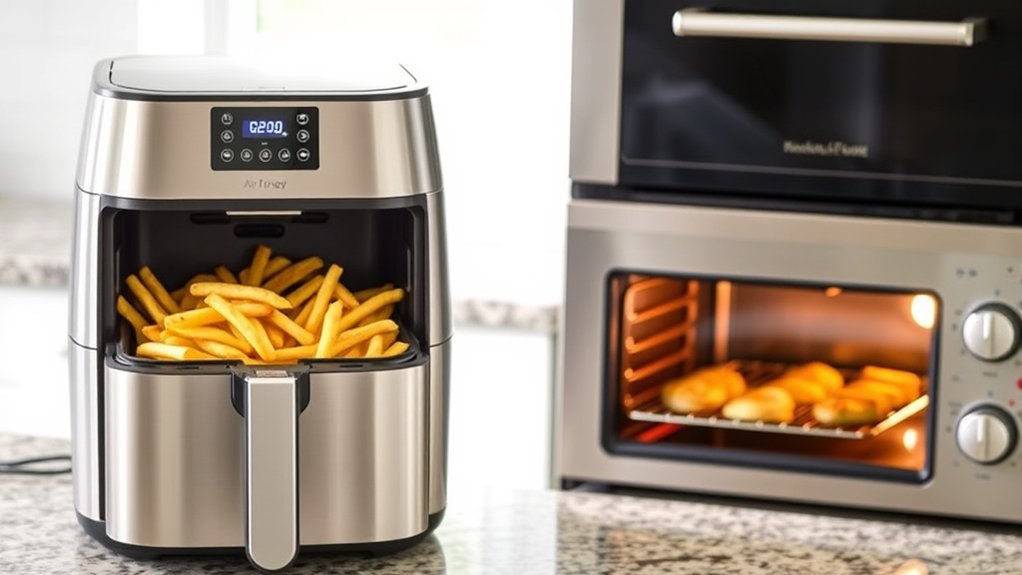
An air fryer is a compact countertop appliance that uses a high-speed fan and a heating element to circulate hot air rapidly around food, producing a browned, crisp exterior with relatively little oil. You control temperature, time, and airflow to manage surface dehydration and Maillard browning.
Its basket or tray pair design maximizes exposed area, so air can contact food on multiple sides and reduce uneven cooking. You load food in a single layer when possible; that limits shielding and improves heat transfer.
Because the chamber is small, it heats quickly and can support better energy efficiency than larger ovens for small batches. You can use it for reheating, roasting, and crisping, but performance depends on food size, moisture content, and load density.
In technical terms, it functions as a forced-convection system optimized for localized, high-velocity circulation rather than bulk thermal capacity.
Is an Air Fryer a Convection Oven?
You can treat an air fryer as a compact convection oven because it uses a heating element and a high-speed fan to circulate hot air around food. It shares the same core heat-transfer principle as a convection oven, but its smaller cavity and more concentrated airflow usually increase surface browning and shorten cook times.
However, you’ll notice performance differences in capacity, temperature distribution, and cooking uniformity, which affect how each appliance handles different foods.
How Air Fryers Work
How do air fryers cook food so quickly? You place food in a perforated basket, then a heating element raises air temperature while a high-speed fan drives concentrated airflow optimization around every surface. That circulation strips away the cooler boundary layer, so heat transfers faster than with still air.
You get browning through rapid moisture evaporation and surface dehydration, which helps proteins and starches set efficiently. Because the chamber is compact, the appliance responds quickly to control changes and maintains tight thermal consistency.
You can also reduce added fat, making it useful for oil alternatives when you want a crisp texture without deep frying. In practice, you’re managing forced hot air, not magic, and the result is fast, predictable cooking with controlled browning.
Convection Oven Similarities
Air fryers and convection ovens both cook with moving hot air, so the underlying heat-transfer mechanism is the same: a fan circulates heated air across the food, accelerating surface drying, browning, and overall cooking speed. You’ll see that both appliances rely on convection, not radiation alone, to move heat efficiently from the chamber air to the food’s exterior.
That shared mechanism explains why you can treat many recipes as transferable between them. The main point is simple: the cooking physics are closely related, which cuts through common convection myths and appliance myths.
When you understand that similarity, you can evaluate directions more analytically and avoid assuming an air fryer uses a fundamentally different process. Both devices are compact convection systems with forced-air circulation and controlled thermal transfer.
Key Performance Differences
Despite the shared convection principle, an air fryer usually delivers higher effective airflow, a smaller cooking chamber, and more aggressive heat concentration than a standard convection oven. You’ll notice faster surface dehydration, sharper browning, and shorter preheat times because the fan-to-volume ratio is much higher.
A convection oven still offers better batch capacity and steadier thermal uniformity for large or delicate loads, but it can’t match the air fryer’s rapid crisping efficiency in compact portions. Many air fryer myths claim it “fries” food with little oil; in reality, it mainly improves heat transfer and evaporation.
From an energy efficiency standpoint, you’ll often use less electricity for small servings, while a convection oven remains practical when you need overall throughput.
How Does a Convection Oven Work?
A convection oven uses a built-in fan to circulate hot air throughout the cooking chamber, which reduces temperature stratification and promotes more even heat transfer to the food. You should think of the fan as a forced-air system that increases convective heat transfer coefficients around each surface.
A convection oven’s fan circulates hot air, reducing stratification and boosting even heat transfer around every surface.
The heating element warms the air, the fan redistributes that air, and the cavity maintains a more uniform thermal field than a static oven. This matters because you get steadier browning and more predictable doneness, especially when load placement changes airflow patterns.
If you’re comparing two word discussion ideas, focus on air velocity and heat distribution rather than unrelated topics. You also need to account for rack spacing, because obstructions can create local recirculation zones and reduce efficiency.
In practice, you’ll see faster heat exchange because moving air removes the insulating boundary layer adjacent to the food.
Air Fryer Vs. Convection Oven Differences
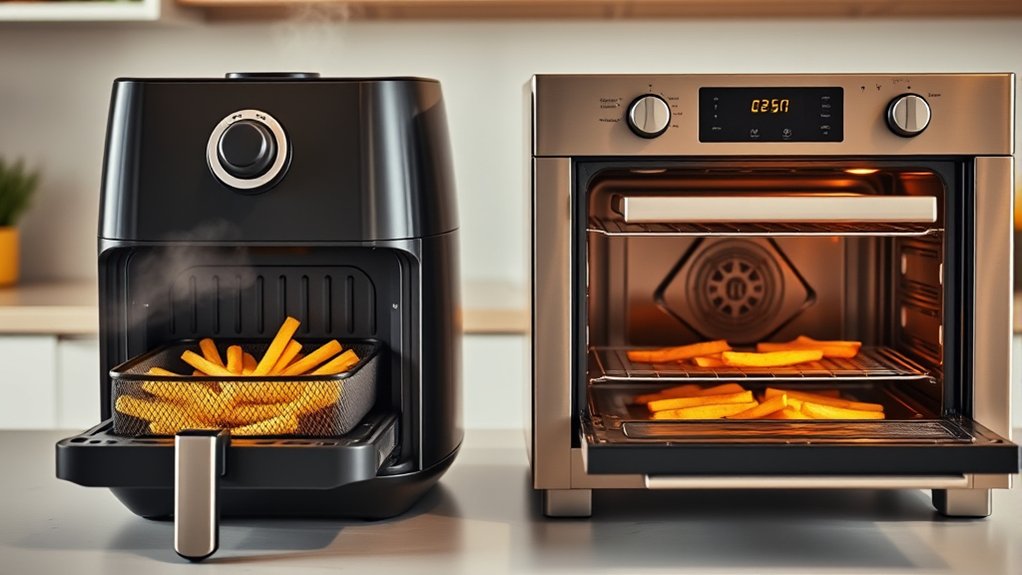
You’ll notice that an air fryer usually cooks faster than a convection oven because its compact chamber and high-velocity airflow concentrate heat more efficiently. In contrast, a convection oven typically takes longer to reach the same browning or crisping level, especially with larger loads.
You should also compare size and capacity, since an air fryer’s limited basket volume restricts batch size while a convection oven handles more food at once.
Cooking Speed Differences
When speed matters, an air fryer usually finishes faster than a convection oven because its smaller chamber and more aggressive airflow move heat more efficiently around the food. You’ll often see shorter preheat times and quicker browning, especially for thin or high-surface-area foods.
That doesn’t mean the appliance is magically faster in every case; air fryer myths often ignore load size and moisture content, while convection myths assume all fan-assisted ovens perform the same. In practice, heat transfer, food geometry, and rack position control the result.
If you’re cooking a small batch, you can expect faster crisping and less idle time. For larger portions, the speed advantage narrows as the system works harder to recover temperature after each addition.
Size And Capacity
Size matters here because an air fryer typically offers far less usable cooking space than a convection oven, even when both use fan-assisted heat. You’ll notice the difference immediately when you compare basket volume with rack area. An air fryer’s compact design limits batch size, but it can improve energy efficiency for small portions.
A convection oven gives you broader coverage and better clearance for sheet pans, casseroles, and multiple racks.
- Air fryer: small basket, tighter airflow
- Convection oven: larger cavity, flexible rack placement
- Air fryer: ideal for singles or pairs
- Convection oven: better for family meals and batch cooking
If you cook unevenly sized items, the oven’s capacity reduces crowding and promotes more consistent browning.
When an Air Fryer Cooks Better
An air fryer often outperforms a conventional oven when you need rapid browning, crisp exteriors, and small-batch cooking with minimal preheating. You get faster heat-up because the compact chamber and high-velocity airflow transfer energy efficiently to the food surface.
That makes it ideal for fries, breaded proteins, roasted vegetables, and reheated leftovers that benefit from dehydration and Maillard browning. You’ll also notice tighter temperature control around small loads, since the basket exposes more surface area than a crowded sheet pan.
Many air fryer misconceptions come from treating it like a mini oven; in practice, its geometry changes airflow and shortens cook times. Likewise, convection myths often assume all forced-air appliances perform the same, but fan speed, cavity size, and food placement alter results.
Use it when you want crisp texture with less oil and fewer steps.
When a Convection Oven Wins
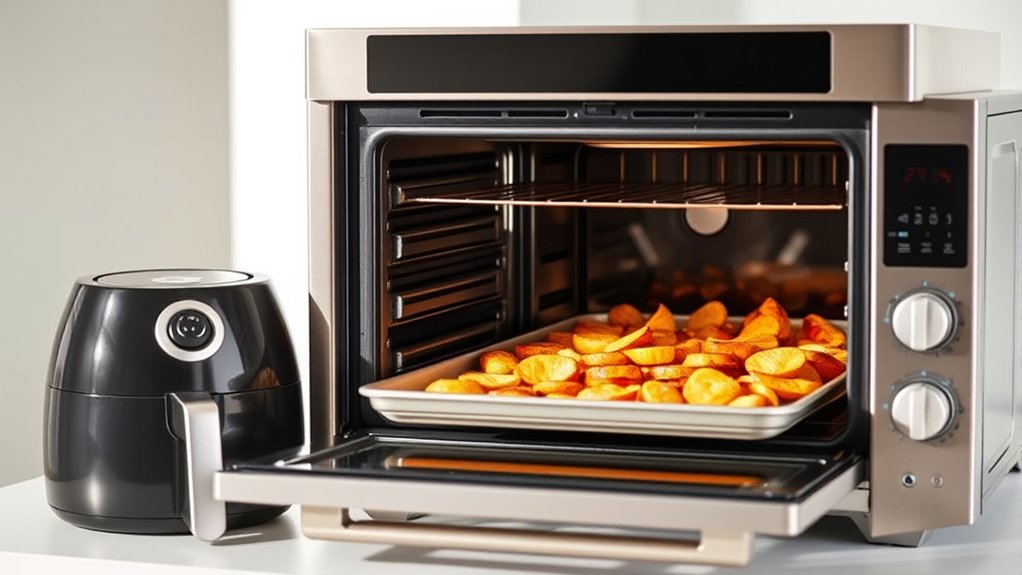
A convection oven wins when you’re cooking larger quantities, bulkier dishes, or foods that need more even heat distribution than intense surface crisping. You get better performance with roasting pans, sheet trays, casseroles, and multiple racks because circulating air reduces hot spots and promotes uniform browning.
That advantage matters when you want consistent internal doneness without over-drying the exterior.
- You need capacity for family-size portions.
- You want stable results across several trays.
- You’re roasting vegetables, meats, or baked dishes.
- You value appliance versatility over speed alone.
Convection myths often overstate air fryers’ superiority; a smaller cavity doesn’t automatically mean better cooking. In practice, a convection oven gives you broader control over load size, pan geometry, and heat transfer.
If your priority is throughput and evenness, not just crisping, the oven is the more capable tool.
How to Choose the Right One
To choose the right appliance, match the tool to your cooking patterns: pick an air fryer if you primarily want fast crisping for small batches, and choose a convection oven if you need greater capacity, more stable heat distribution, and better performance with pans, trays, or multi-rack cooking.
You should also inspect your workflow: if you reheat frozen foods, roast vegetables, or cook one or two portions, an air fryer can reduce preheat time and energy use. If you bake, sheet-roast, or prepare family meals, a convection oven gives you tighter control over airflow and spacing.
Don’t let air fryer myths or convection oven myths distort the decision; neither appliance is universally “better.” Instead, compare cavity size, rack geometry, temperature uniformity, and cleanup demands. You’ll get the best results when you align the appliance’s heat profile with your batch size, cookware, and recipe mix, not with marketing labels or simplified comparisons.
Frequently Asked Questions
Can You Bake a Cake in an Air Fryer?
Yes, you can bake a cake in your air fryer if you adjust the baking technique and account for equipment comparison. You’ll need a smaller pan, lower temperature, and shorter cook time for even results.
Do Air Fryers Use Less Electricity Than Ovens?
Usually, you’ll use less electricity with an air fryer than an oven because it heats faster and cooks smaller loads.
In this energy comparison, convection efficiency matters: less air volume means lower power and shorter runtimes.
Can You Reheat Leftovers Better in an Air Fryer?
Yes, if you want crisp, even reheating leftovers, you’ll often get better texture in an air fryer. With the right air fryer setup, you can warm food quickly, analyze doneness precisely, and avoid sogginess.
Are Air Fryer Baskets Dishwasher Safe?
Yes, you’re safe to check the manufacturer’s dishwasher compatibility first; many baskets are dishwasher safe. For proper air fryer maintenance, you should remove nonstick-coated parts carefully, avoid abrasives, and dry components thoroughly after cleaning.
How Do You Clean Burnt Food From an Air Fryer?
You clean burnt food by soaking the basket in hot, soapy water for 15 minutes, then scrubbing gently; I’ve seen a crust vanish like chalk.
Use baking soda paste for stubborn spots. One of my best cleaning tips.
Conclusion
So, is an air fryer a convection oven? Yes, but with important design differences. You get the same forced-air heat transfer, yet the air fryer’s compact chamber and perforated basket intensify browning and crisping.
If you want fast, dry, high-surface-area cooking, it can feel like a tiny tornado of heat. If you need larger capacity or gentler baking, a convection oven’s broader, steadier airflow still wins.
Choose based on your food, volume, and texture goals. In conclusion, while an air fryer is essentially a convection oven, its unique design sets it apart in performance and cooking style.