How Does a Microwave Oven Work
You probably don’t know that a microwave oven doesn’t heat food from the inside out by magic; it drives a magnetron that converts electricity into 2.45 GHz radiation.
That energy travels through a waveguide into the cavity, where it makes polar molecules in your food oscillate and generate heat.
But the real story starts with how the oven controls those waves, and that’s where things get interesting.
Key Takeaways
- A microwave oven uses a magnetron to convert electricity into microwaves.
- A waveguide sends microwaves into the cooking cavity, where reflective walls keep the energy contained.
- Microwaves heat food by making water molecules rotate, creating internal friction and heat.
- A turntable, stirring, and standing time help spread heat more evenly and reduce cold spots.
- Safe operation depends on microwave-safe containers, a closed door interlock, and avoiding metal or sealed containers.
How a Microwave Oven Works
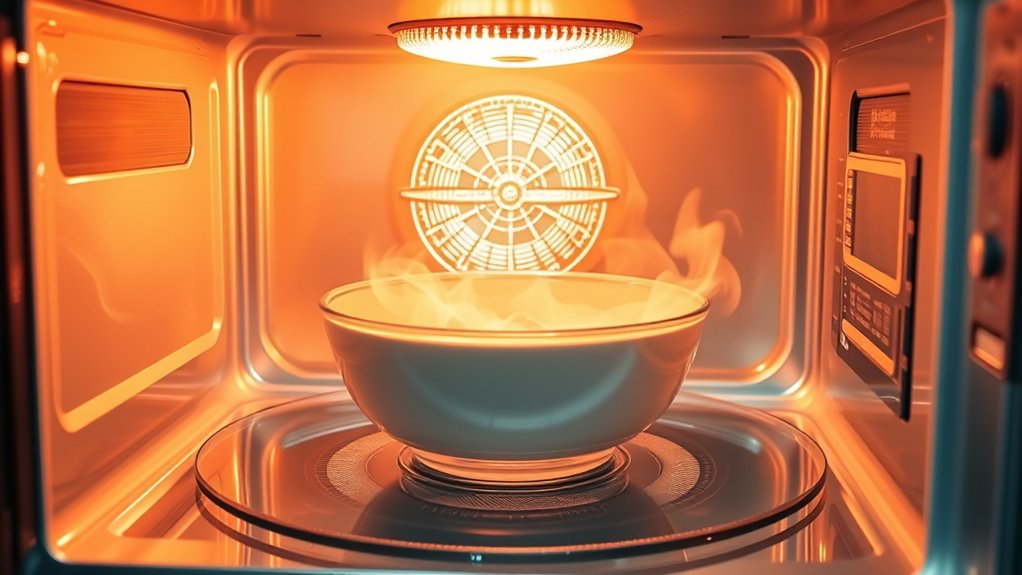
A microwave oven works by converting electrical energy into electromagnetic waves called microwaves, which are generated by a device called a magnetron. When you start the oven, the control system supplies power to the magnetron, and the waveguide directs that energy into the metal cooking cavity.
A microwave oven converts electrical energy into microwaves, using a magnetron and waveguide to heat food.
You see a rotating turntable in many models because it helps distribute exposure more evenly within the chamber. The interior walls reflect the waves, so the oven contains the radiation instead of letting it escape.
You also rely on a door interlock system, which prevents operation when the door isn’t fully closed. These components work together as an engineered system, not as an unrelated topic.
In kitchen design, manufacturers place vents, controls, and viewing windows to balance function, safety, and usability. The oven’s exterior stays insulated and grounded, which supports safe operation and efficient installation in your kitchen.
How Microwave Energy Heats Food
Microwave energy makes water molecules in your food rotate rapidly, and that motion generates heat through dielectric heating. You’ll see the strongest heating where the field couples most effectively with moisture, so foods with different water content warm at different rates.
This creates uneven heat distribution patterns, which is why microwaves often heat some areas faster than others.
Water Molecule Rotation
When microwaves enter the oven cavity, they interact strongly with water molecules in the food, causing those polar molecules to rotate rapidly as they try to align with the alternating electric field.
You can think of each water molecule as a tiny magnet with a positive and negative end, so the field forces constant reorientation. This spin alignment reverses billions of times per second, and that rapid motion creates molecular friction within the food’s structure.
As the molecules jostle against neighboring molecules, they transfer energy through the material. Because water is abundant in many foods, it absorbs microwave energy efficiently and distributes it locally.
The result is a direct conversion of electromagnetic energy into thermal motion, which raises temperature from the inside throughout.
Dielectric Heating Process
This molecular rotation is part of a broader dielectric heating process, where alternating electromagnetic fields make polar molecules in food continually reorient and dissipate energy as heat. You expose the food to a rapidly oscillating microwave field, and the field forces dipoles, especially water, to align, then reverse direction millions of times per second.
That repeated molecular rotation creates internal friction at the molecular scale, and this friction converts electromagnetic energy into thermal energy. The efficiency of this conversion depends on the material’s ability to absorb microwave energy, which engineers describe as dielectric loss. Higher dielectric loss means you convert more field energy into heat.
Because the energy deposits directly inside the material, you heat the food without relying on the oven cavity walls to warm it first.
Heat Distribution Patterns
Why does microwave-heated food often come out unevenly warm? You’re seeing heat distribution shaped by standing waves inside the cavity. The magnetron emits microwaves that reflect off metal walls, then overlap to form zones of high and low field intensity.
Food absorbs energy most strongly where the field is stronger, so some regions heat faster than others. Density, water content, shape, and thickness further change how deeply energy penetrates, which increases heat nonuniformity.
A rotating turntable helps average exposure, but it can’t eliminate all hot and cold spots. Stirring, covering, and resting the food after heating let conduction spread energy from hotter regions to cooler ones. That’s why microwave cooking depends on both electromagnetic absorption and thermal equalization to improve final temperature uniformity.
The Main Parts Inside a Microwave Oven
Inside a microwave oven, several key parts work together to generate, control, and distribute microwave energy. You’ll find the magnetron, waveguide, turntable motor, and control circuit among the main inside parts.
The magnetron converts electrical power into microwaves, while the waveguide channels that energy into the cavity. The turntable motor rotates food so exposure stays more even, and the control circuit times each cycle with precision. Understanding these naming conventions helps you identify each component quickly.
| Part | Function |
|---|---|
| Magnetron | Produces microwave energy |
| Waveguide | Directs energy into the oven cavity |
You also rely on the cavity walls to reflect energy inward, which improves interaction with the load. The door latch and safety interlocks prevent operation when the door isn’t sealed. Together, these components form a controlled system that delivers energy efficiently and safely.
Why Some Foods Heat Faster
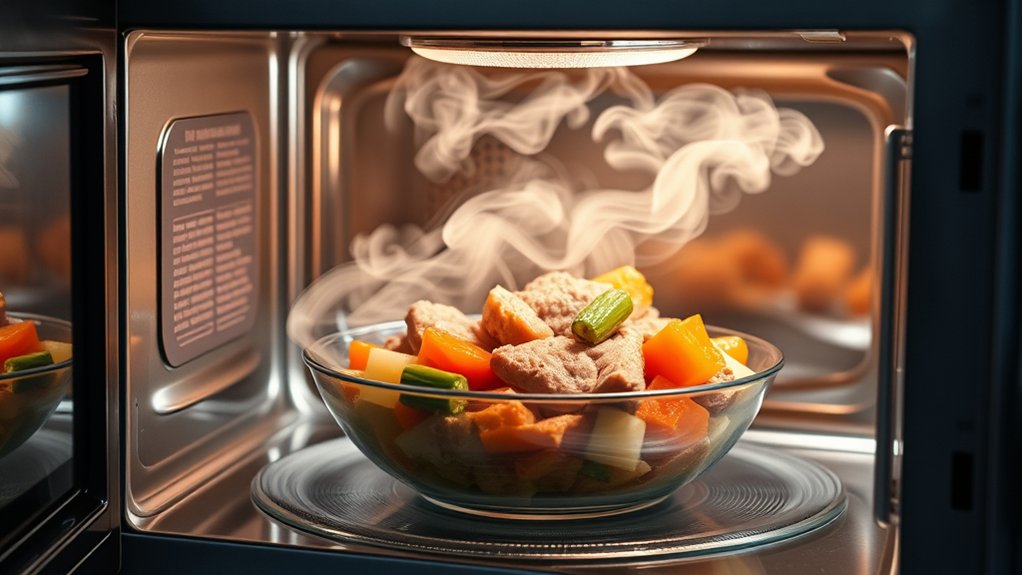
Some foods heat faster because microwaves don’t spread heat evenly through every material in the same way. You notice faster warming when a food contains more free water, because polar molecules absorb microwave energy and convert it to motion. Dense, uniform foods often heat slowly, while porous or irregular foods create hot and cool regions.
A second key factor is two word idea, which changes how deeply energy penetrates and how quickly surfaces and centers respond. Two word idea also matters because dissolved salts, sugars, and fats alter dielectric behavior, so the same power can produce different temperatures.
High water content absorbs energy efficiently.
Uneven density creates temperature gradients.
Thickness limits how far waves penetrate.
Composition changes energy absorption rates.
When you compare foods, you’re seeing material properties, geometry, and moisture content working together, not just the oven’s power setting.
Microwave Safety and Common Mistakes
Microwave safety starts with the material you put in the oven, because the wrong container can overheat, warp, or release chemicals into food. You should use only microwave-safe glass, ceramic, or labeled plastic, and you should avoid metal, foil, and cracked dishes.
Common mistakes also include sealing containers tightly, heating eggs in shells, and forgetting to stir dense foods. Those errors can trap steam, create pressure, or leave cold spots that raise risk.
| Safe choice | Risky choice |
|---|---|
| Labeled glass | Thin plastic |
| Ceramic bowl | Metal trim |
| Vented lid | Tight seal |
| Stirred food | Uneven heating |
| Short intervals | Overheating |
You improve microwave safety by checking labels, covering food loosely, and pausing to redistribute heat. If a container smells strange, softens, or bends, stop immediately and replace it. Small precautions prevent burns, spills, and ruined meals.
Inside a Microwave Heating Cycle
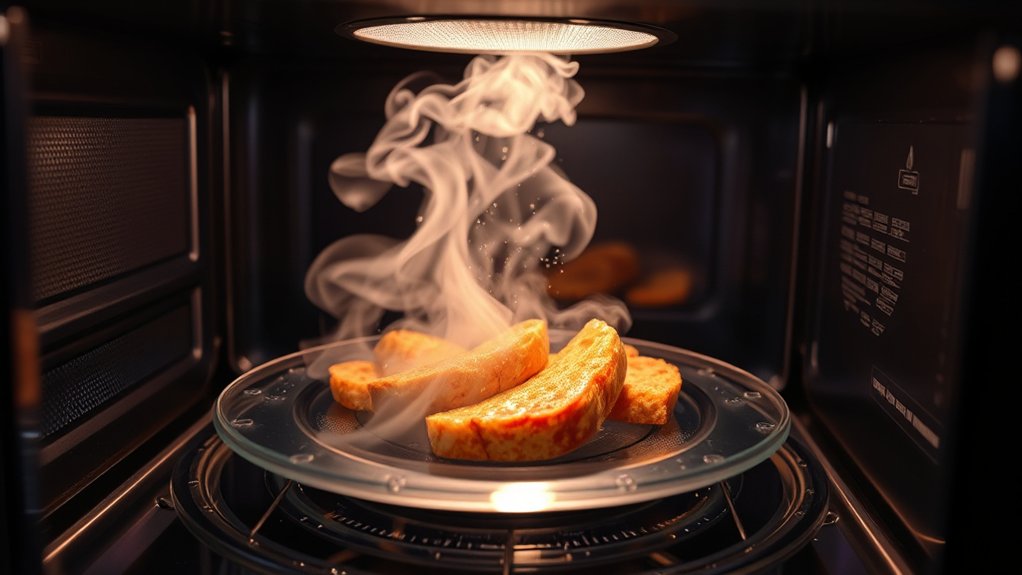
When you start a heating cycle, the oven’s magnetron converts electrical energy into microwave radiation and sends it into the cooking cavity. The waves reflect from the metal walls and penetrate your food, causing polar molecules, especially water, to rotate rapidly.
That motion produces heat throughout the mass, so you get inside cooking rather than surface-only warming. The turntable and mode stirrer help distribute energy more evenly, reducing hot spots.
As the cavity fills with alternating fields, the magnetron cycles on and off to maintain output, which can create a brief magnetron noise you hear during operation.
- Microwaves interact most strongly with water-rich regions.
- Energy absorption rises where dielectric losses are highest.
- Heating begins near the surface and moves inward by conduction.
- The door screen blocks radiation while letting you observe the cycle.
Microwave Tips for Better Results
For more even heating, you should arrange food in a ring or spread it in a thin layer, since the oven’s energy pattern is strongest near the outer regions of the cavity. These microwave tips help you reduce cold spots and overheating by matching food geometry to field distribution.
You should cover dishes loosely to trap steam, which improves heat transfer and prevents surface drying. Stir liquids and rotate dense foods halfway through heating so you redistribute thermal energy before hotspots develop.
Use microwave-safe containers with low thermal mass, because they heat less and let energy enter the food faster. Cut large portions into smaller, uniform pieces to shorten the conduction distance from the exterior to the center.
If your oven has a turntable, keep it moving and avoid blocking its path. Let food stand briefly after cooking; residual heat will equalize temperatures and give you better results.
Frequently Asked Questions
What Wattage Is Best for Microwave Cooking?
You’ll usually get the best results with 900 to 1,200 watts; that’s ideal for even heating and faster cooking. For lower-power units, adjust time carefully, follow best practices, and prioritize kitchen safety throughout.
Can Metal Ever Be Safe in a Microwave?
Yes, some metal’s safe in a microwave if you follow metal safety rules and proper dish placement. You can use smooth, small amounts, like trim or racks, but avoid foil, crumpled metal, and damaged containers.
Why Do Microwaves Sometimes Make Food Explode?
You sometimes trap steam like a pressure-cooker tale; when hot pockets burst, food explodes. Microwaves interact with water unevenly, creating superheated pockets and rapid vapor expansion.
Browning stays limited because surface temperatures rarely climb enough.
How Do I Test if My Microwave Leaks Radiation?
You can’t reliably test leakage yourself; use certified frequency safety testing. You should inspect how to check door seal, hinges, and latch alignment, then have a technician measure emissions with a calibrated microwave leakage meter.
What Causes a Microwave to Stop Heating?
Usually, you’ve got a failed magnetron, diode, capacitor, door interlock, or control board; think of it like a power river blocked by debris.
You should check chip safety and kitchen regulations before testing repairs.
Conclusion
In short, your microwave oven turns electricity into a flood of microwave energy that can heat food in seconds, almost like a tiny lightning storm trapped in a box. The magnetron sends waves into the cavity, water molecules absorb that energy, and the food heats from the inside out.
With its turntable, controls, and safety interlocks, your microwave is a compact, carefully engineered system that makes fast heating look almost effortless.
This combination of technology and design is what makes a microwave oven such an essential appliance in modern kitchens.