When Was the Microwave Oven Invented
If you’re asking when the microwave oven was invented, the answer starts in the mid-1940s, when Percy Spencer at Raytheon noticed magnetron energy could heat food unexpectedly.
In 1945, engineers turned that wartime technology toward cooking, and by 1947 the first commercial Radarange appeared. Early units were large and specialized, but they set the stage for the compact kitchen appliance you know today.
The next step in that evolution is where the story gets interesting.
Key Takeaways
- Percy Spencer discovered microwave heating accidentally in the mid-1940s while working at Raytheon on magnetrons.
- Raytheon turned that discovery into a practical heating appliance in 1945.
- The first commercial microwave oven, the Radarange, was introduced in 1947.
- Early microwave ovens were large, water-cooled units mainly used in restaurants and institutions.
- Home microwave adoption came later, as compact, safer, cheaper models reached consumer kitchens.
When Was the Microwave Oven Invented?
If you’re asking when the microwave oven was invented, the answer begins in the mid-1940s, when engineer Percy Spencer at Raytheon accidentally uncovered that microwave energy could heat food. You can place the invention’s turning point in 1945, when Raytheon moved from laboratory insight to a practical heating appliance.
In 1947, the company introduced the first commercial microwave oven, the Radarange, a large, water-cooled unit aimed at restaurants and institutions. That date matters because you’re tracing the oven’s shift from wartime radar technology to domestic possibility.
Historical records also show inventor controversy and patent disputes surrounding credit for the breakthrough, since Spencer’s role sits within a broader corporate research system. When you study the timeline, you see that the microwave oven wasn’t a single overnight invention; it emerged through testing, engineering refinement, and legal claims that shaped how history remembers its origin.
How Percy Spencer Discovered Microwaves
Percy Spencer’s discovery of microwave heating came from hands-on wartime research at Raytheon, where he worked on high-powered magnetrons used in radar systems. You can trace the breakthrough to his inventor’s curiosity: he noticed a candy bar melted in his pocket while he stood near an active tube.
Percy Spencer’s microwave breakthrough began with wartime radar research and a candy bar that melted in his pocket.
Instead of dismissing the accident, he tested the effect with other foods and found that energy from the magnetron could heat them quickly. In 1945, this observation shifted microwave research from military electronics toward domestic possibility.
You should see this moment as a careful scientific pivot, not a lucky mishap. Spencer recognized that the same invisible energy that supported radar might also transform cooking, provided engineers could address kitchen safety and control the exposure.
His observation opened a new field of appliance design and led researchers to explore practical, enclosed heating methods for everyday use.
How the First Microwave Prototype Worked
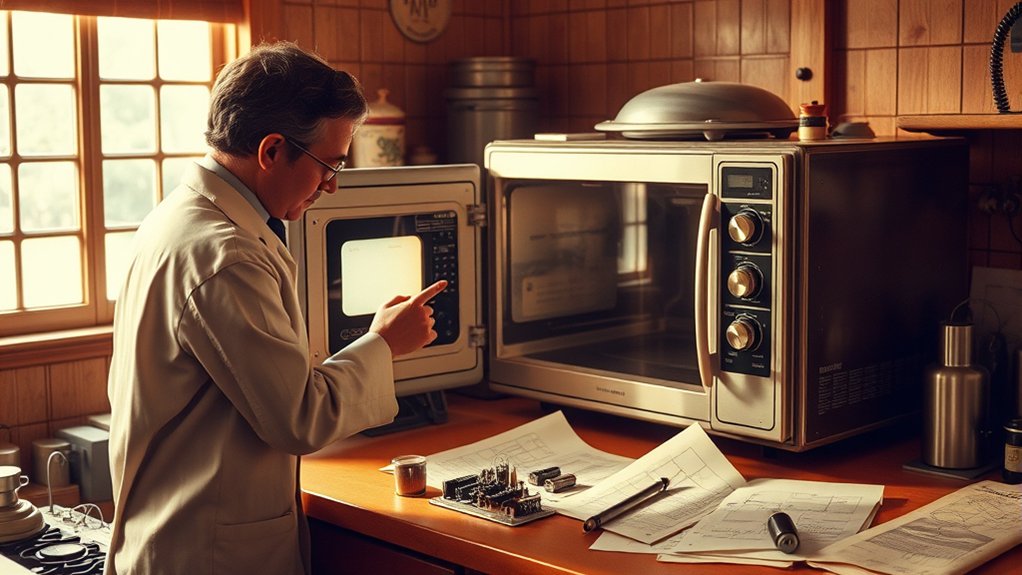
To turn Spencer’s insight into a workable appliance, Raytheon built an early prototype that directed magnetron-generated microwaves into a metal enclosure. You’d see engineers treating the chamber like a controlled experiment, not a household tool, because the goal was to trap energy and observe heat transfer precisely. Unlike solar energy, which warms surfaces gradually, these waves agitated water molecules fast, producing heat inside food itself.
- A magnetron supplied high-frequency radiation.
- A reflective metal box concentrated the waves.
- Early tests used corn, eggs, and other moisture-rich samples.
You can think of the setup as a scientific china shop: one wrong adjustment could shatter the results, and even the container choice mattered. Researchers measured how quickly the cavity converted electrical power into thermal change, refining wave paths and shielding to limit leakage. That prototype proved the principle, showing microwave cooking wasn’t magic. It was engineered electromagnetic heating.
How the Microwave Oven Reached Home Kitchens
How did a laboratory breakthrough become a countertop appliance? You can trace the shift to postwar manufacturing, when engineers shrank magnetron systems, improved shielding, and cut costs enough for consumer markets.
Early commercial units, introduced in the late 1940s and 1950s, first served diners, railcars, and institutional kitchens, where operators valued speed and consistent output. That commercial credibility helped build trust before home adoption.
By the 1960s, firms like Amana and others pursued compact cabinets, simpler controls, and better ventilation, making the appliance safer and easier to place in ordinary kitchens. Marketing framed it as kitchen innovation, not novelty, while retailers demonstrated its convenience and reliability.
As prices fell and households gained more electricity and counter space, tech adoption accelerated. You see a classic pattern: industrial invention, niche use, consumer refinement, then broad domestic acceptance.
How Microwaves Changed Everyday Cooking
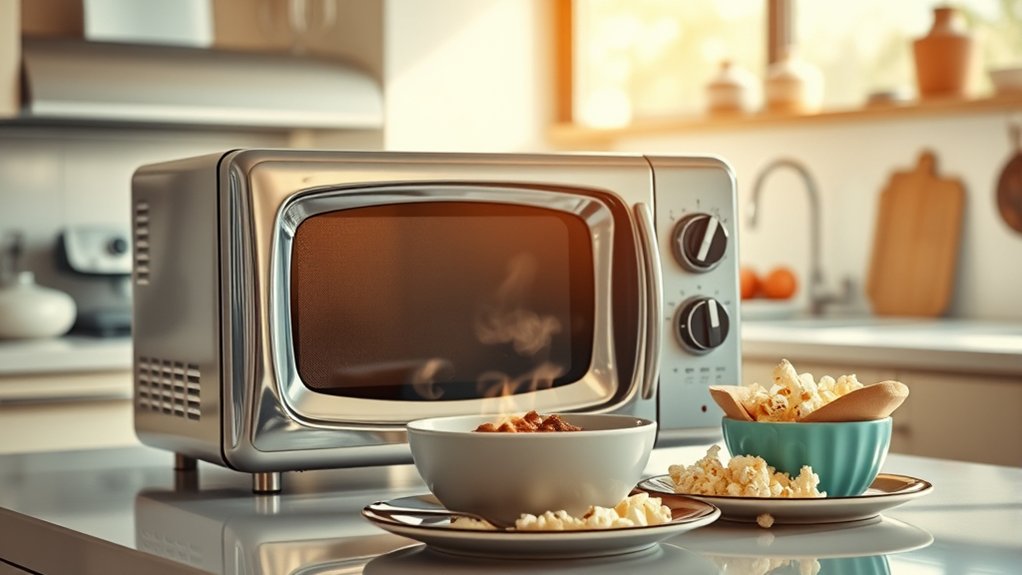
Microwaves changed everyday cooking by shifting the rhythm of meal preparation from long, heat-intensive sessions to fast, on-demand heating. You could reheat leftovers, thaw meat, and soften butter in minutes, and that convenience reshaped kitchens after the postwar rise of household electrification.
Historians note that the appliance didn’t replace stoves; it redistributed tasks, making quick cooking practical for busy households and smaller living spaces. Its adoption also challenged historical myths that modern cooking always needed flames or long simmering.
- You gained precise timing for reheating and defrosting.
- You reduced fuel use compared with prolonged oven heating.
- You adapted recipes around rapid, localized energy transfer.
To understand the change, you should trace electricity origins in domestic life: once current reached homes reliably, microwaves fit a broader story of automated labor, measured power, and shrinking preparation time.
Frequently Asked Questions
How Much Did the First Microwave Ovens Cost?
The first microwave ovens cost you about $2,000 to $3,000 in the late 1940s, reflecting early pricing for bulky, commercial units. A first microwave could reach far more, depending on model and installation.
What Foods Should Never Be Microwaved?
You shouldn’t microwave eggs in shells, sealed jars, or whole grapes; they can explode or spark.
For food safety and appliance maintenance, you should avoid superheating liquids, since they erupt unpredictably.
How Do Microwave Ovens Affect Food Nutrition?
Microwave ovens usually preserve more nutrients than boiling because you cook quickly with little water. You’ll see some vitamin losses from heat, but overall the nutrition impact is modest.
Microwave safety depends on proper container use.
Who Invented the Countertop Microwave Oven?
You’d credit Percy Spencer, a Raytheon engineer, for the countertop microwave oven’s invention. His innovator missteps with radar technology led to the first prototype.
Later, marketing challenges delayed consumer adoption until 1950s commercialization.
How Often Should a Microwave Oven Be Cleaned?
Like clockwork, you should clean your microwave weekly, and immediately after spills. Research on cleaning frequency shows this prevents odor buildup and sparks.
Follow maintenance tips: wipe interiors, clean the door seal, and inspect vents routinely.
Conclusion
You can picture the microwave oven as a wartime spark that grew into a kitchen lantern. Percy Spencer’s 1940s discovery showed you how magnetrons could turn invisible waves into heat, and Raytheon’s 1947 Radarange proved the idea in metal form.
As compact models arrived in the 1960s, you watched a once-clumsy machine become a household guide, quietly changing how you cook, save time, and trust modern technology. This evolution highlights the significance of when the microwave oven was invented, marking a pivotal moment in culinary history.